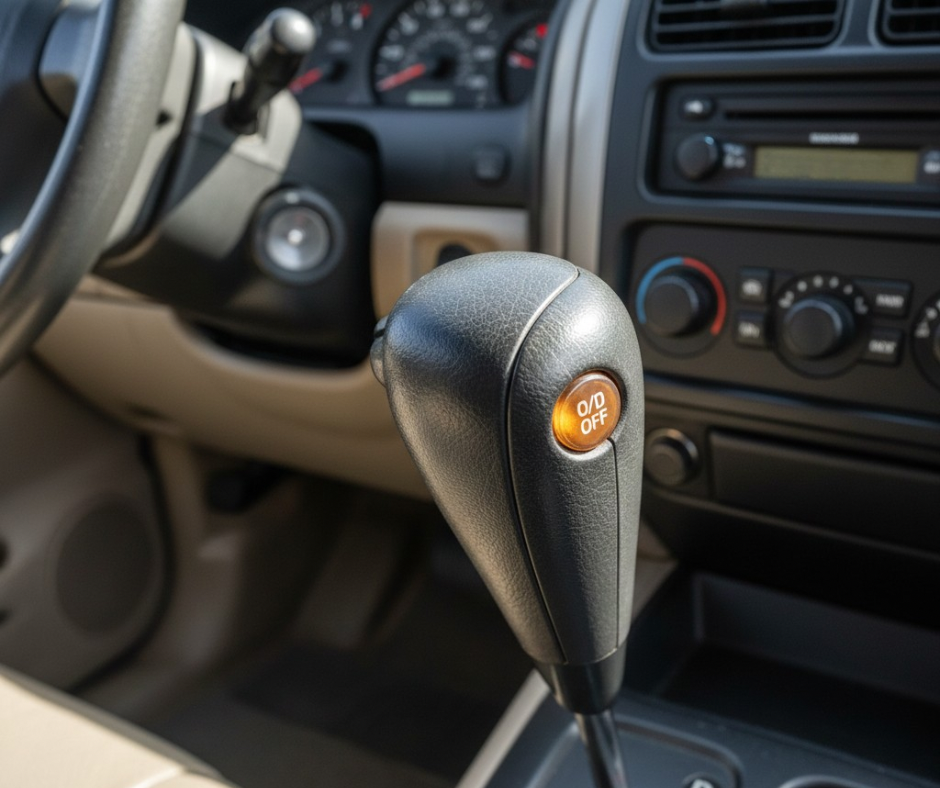
What is overdrive?
The perfect analogy: Think of overdrive as the top gear on a 21-speed mountain bike. When you are starting from a stop or pedaling up a big hill, you use a low gear. It is easy to pedal, but your legs move really fast and you don’t go very far with each rotation. Once you are on a flat road and moving fast, you switch to that highest gear. Now, you only have to pedal slowly to keep the bike flying down the road. That is exactly what overdrive does for your car.
The high-speed cruising gear: When you get onto the highway and reach speeds over 40-45 mph, your car shifts into overdrive. At this point, the wheels are actually spinning faster than the engine. This allows the engine to “relax” and run at a much lower speed while the car continues moving quickly.
Why it matters to you:
• It saves you money because the engine uses less gas when it isn’t working as hard.
• It makes the ride quieter because the engine isn’t roaring at a high pitch.
• It keeps your engine from wearing out too quickly.
Which Cars Have It?
Most modern cars have this feature, but not all of them give the driver the ability to disengage it manually. Today, most trucks and SUVs have a “Tow/Haul” button or a “Sport” mode that does the exact same thing (and more) automatically.
Some new cars use a Continuously Variable Transmission (CVT), which doesn’t have “gears” at all. It just smoothly slides into an infinite number of ratios, essentially staying in “perfect overdrive” whenever you are at a steady speed.
While you won’t find an actual overdrive button on a brand-new car today, you can find them on millions of vehicles still on the road from the 1990s through the mid-2010s.
Where to look for it:
If your car has one, it’s usually in one of two places:
1. On the Shifter: A tiny round button located just below the main release button on your gear shift lever.
2. On the Dash: A square button labeled “O/D Off” near your steering wheel or climate controls.
When Should You Turn It Off?
You should leave it on for almost all normal driving. The only time you really need to turn it off is:
- Towing or Hauling Heavy Loads: When your car is carrying extra weight, overdrive can cause the transmission to shift back and forth constantly (this is called “hunting”). Turning it off gives your car more steady pulling power and prevents the transmission from overheating.
- Climbing Steep Grades: If you are driving up a mountain road and feel the car struggling or “bogging down,” turning overdrive off keeps the engine in a higher power range so it can climb without gasping for air.
- Quickly Passing or Merging: Think of this as your “power” button. If you need a sudden burst of speed to merge into fast traffic or pass a slow truck, turning overdrive off forces the car into a lower gear. This makes the gas pedal feel much more responsive and snappy, giving you instant acceleration without the delay of a computer downshift.
Always Here To Keep You Moving
Whether you have a physical button or a modern car that handles it all behind the scenes, understanding overdrive helps you become a more confident driver. If you notice a light on your dash that says O/D OFF, don’t panic—you likely just bumped the button on your shifter, and a quick click will get you back into that fuel-saving cruising gear. Keeping your transmission shifting smoothly is one of the best ways to extend the life of your vehicle. If your car is struggling to find the right gear or if that warning light won’t go away, swing by the shop and we will make sure your transmission is ready for your next highway adventure.